Choose off-the-shelf software for jobs that work the same in every business (accounts, email, a standard sales pipeline) and bespoke where your process is your edge, where four or more systems need joining up, or where you must control the code, the data and where it is hosted. Many businesses land on a hybrid: products for the standard work and a bespoke system or integration for the rest. A typical bespoke internal system takes 10 to 16 weeks including discovery, and you should own the code and data outright from day one.
The short answer: buy the standard, build the difference
Off-the-shelf software is the right choice for anything that works the same way in most businesses: accounts, payroll, email, a standard sales pipeline, an online shop. Bespoke earns its place where your process differs from everyone else's, where the real work happens between systems, or where you need to own the code, the data and the roadmap.
Most UK businesses end up with a mix: Xero or Sage, Microsoft 365, and one bespoke system or integration for the part no product fits.
| Situation | Usually wins | Why |
|---|---|---|
| Accounts, payroll, tax returns | Off the shelf | Regulated, identical for every business, and Xero, Sage and QuickBooks do it well. Never build your own ledger. |
| A sales team with a normal pipeline | Off the shelf | HubSpot, Pipedrive or Zoho will fit most of the need within a week or two. |
| A process that is your competitive edge | Bespoke | A product makes you work the way its designers assumed, which is the way your competitors work. |
| Five tools joined by spreadsheets and retyping | Integration, or bespoke | The pain is in the gaps. Often the answer is joining the tools, not replacing them. |
| Customers or suppliers need to log in to your data | Often bespoke | Portals need your own rules, branding and links to your own systems. |
| You need it live in four weeks | Off the shelf | A bespoke build of any size takes 8 to 16 weeks including discovery. |
Fit to the process
Every product carries a set of assumptions about how work flows: what a customer is, what a job is, which steps come in which order and who approves what. When those assumptions match yours, the product feels effortless. When they do not, your staff absorb the difference with workarounds.
Count the workarounds during a trial. Three or four is normal. Fifteen means the product does not fit, however good the demo looked. Typical signs:
- Staff keep a spreadsheet next to the system, just in case.
- Custom fields called Misc 1, Misc 2 and Notes 3 hold data the product has no concept of.
- A process step happens in email or WhatsApp because the product has no status for it.
Bespoke software is built the other way round. We start from how your team actually works, write it down, and build screens, rules and reports to match, including the awkward cases (a customer with two delivery addresses and three different terms).
The risk flips too. You get exactly what you specified, so the specification has to be right. That is why our builds start with a discovery and specification phase and a clickable prototype that your staff try before any production code is written.
Ownership of code and data, and vendor lock-in
With an off-the-shelf product you own your data, subject to the contract, and nothing else. The code, the hosting, the feature set and the terms all belong to the vendor. That becomes a problem when the vendor is acquired, drops a feature you rely on or changes its terms.
Lock-in rarely comes from the raw data, since most products will give you a CSV. It comes from everything around the data: the workflows, automations, permissions, templates and reports you configured, none of which export in any useful form. Audit trails, comments and attachments often come out partially or not at all. Test the export during the trial, not on the way out.
| What | Off the shelf | Bespoke with Fixology |
|---|---|---|
| Source code | The vendor's | Yours, in your own repository from day one |
| Database | Hosted by the vendor, exported on request | Your database, in your own hosting account |
| Exit route | Export, then rebuild your workflows somewhere else | Hand the repository to another team |
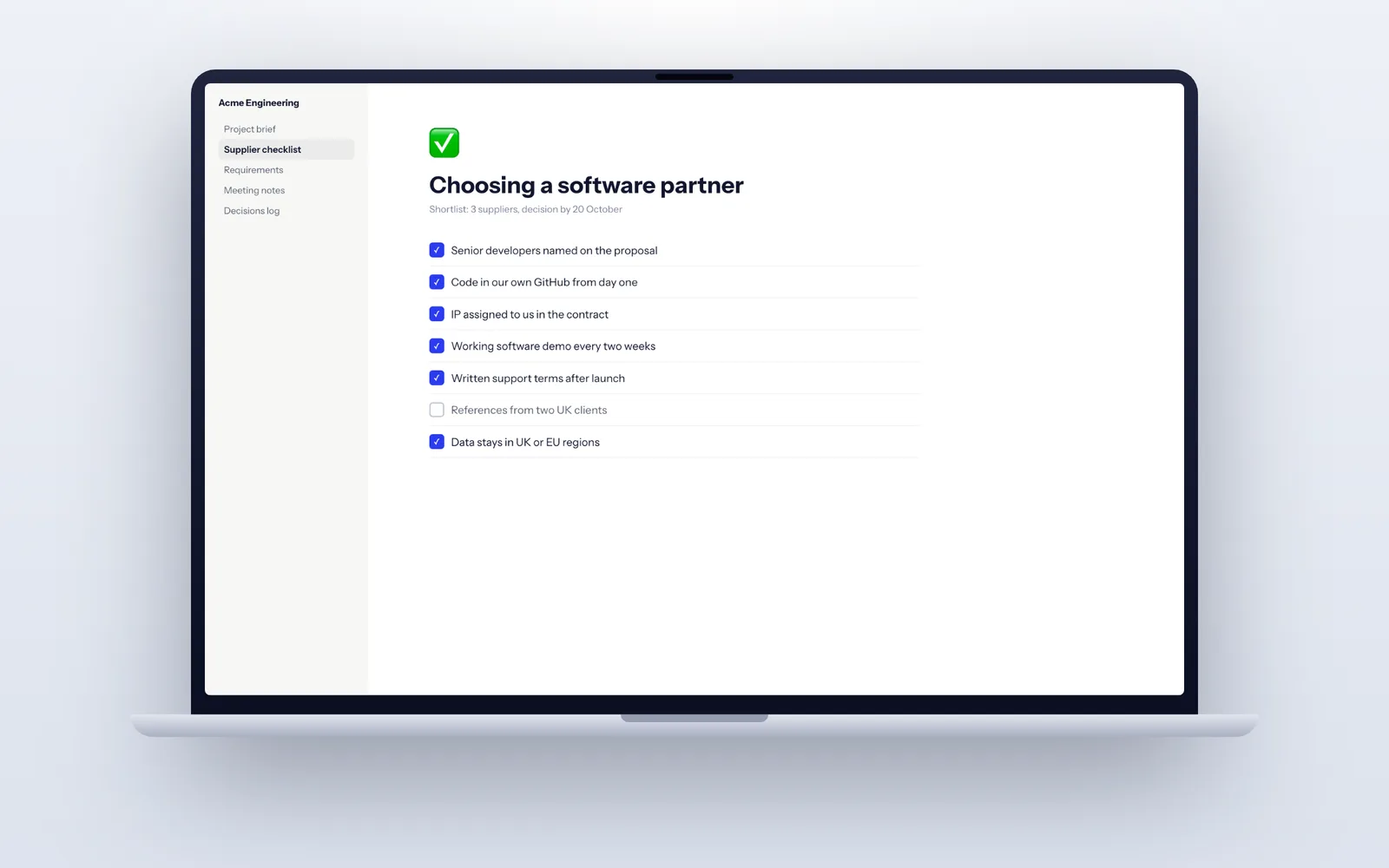
With bespoke software you should own everything: the source code, the database, the hosting account and the intellectual property. At Fixology this is standard, not a negotiation. The repository sits in your company's GitHub or Azure DevOps account from day one, hosting is in your name, and copyright is assigned to you in the contract. Our guide on what happens if your software developer goes bust explains how to check this before you sign with anyone.
Integration with the systems you already run
A typical UK business runs Xero or Sage, Microsoft 365, a CRM such as HubSpot or Salesforce, and one or two sector tools. How a new system talks to those matters as much as what it does on its own.
Products connect well to popular tools through ready-made connectors. The limits show when you need something the connector does not do: a custom field, a business rule in the middle, proper failure handling, or an older system with no API. You are then relying on a connector you cannot change, or on glue such as Zapier or Make. Our comparison of Zapier vs Make vs n8n covers when that glue is enough.
Bespoke systems treat integration as part of the design from the first week. We write directly against the APIs of Xero, Sage, HubSpot, Microsoft Graph, Shopify, couriers and banks, with retries, logging and alerts, so a broken sync is noticed in minutes rather than at month end. Where an older system has no API, we work with database access, file drops or scheduled exports.
Control of the roadmap, and room to grow
With a product, the vendor decides what gets built next. Your feature request joins thousands of others and will be built if it suits the vendor's wider customer base.
With bespoke software you decide, sprint by sprint. A new regulation, product line or customer type becomes a change you schedule, not a request you hope for. The trade-off is that nothing improves unless you commission it, so bespoke works best when someone on your side owns the system as a product.
Scale follows the same pattern. Products hit API rate limits, record caps and slow reports over large data sets. A bespoke system is designed around your volumes: indexes for the queries you actually run, background jobs for heavy work, and cloud hosting on AWS or Azure that scales up for peaks. Built on a sound data model, it can grow from 20 users to several hundred without a rewrite.
Security and UK GDPR
Both routes can be secure, and both can be insecure. The real difference is who carries which responsibility.
With a product, the vendor runs the infrastructure, patches it, and usually holds independent security certifications such as ISO 27001 or a SOC 2 report, so ask to see them. You remain the controller under UK GDPR, which means you still need a data processing agreement with the vendor, a list of its sub-processors and a clear answer on where your data is stored and processed. If any of it leaves the UK, there must be a lawful transfer mechanism.
With bespoke software you decide the answers. Hosting can sit in a UK region such as AWS London or Azure UK South, access can be as fine-grained as your rules need, and the audit log records exactly what you will need to prove later. The control comes with responsibility: the system needs patching, monitoring and security testing for its whole life, so build that into support from the start. Our security and UK GDPR page sets out how we build, host and test.
Speed to go live, and support afterwards
Off the shelf wins on speed to first use. A product can be in use within days and properly configured within a few weeks. Data migration and training still take time.
| Route | Typical time to go live |
|---|---|
| Off the shelf, as is | Days to two weeks |
| Configured platform | 3 to 8 weeks |
| Integration between existing tools | 4 to 8 weeks |
| Typical bespoke internal system | 10 to 16 weeks including discovery |
| Large ERP or legacy replacement | 16 to 40 weeks, released in phases |
Bespoke takes longer, but you do not wait until the end to see it. We work in two-week sprints with a demo on a test link at the end of each one, so you are using working software within the first month and steering it as it takes shape. A large system can go live in phases, with the first release in 8 to 12 weeks. Our software development process walks through each stage.
Support differs too. Product support is a shared ticket queue. Bespoke support comes from the team that built the system. Every Fixology build has a 30 day warranty after launch, followed by an ongoing support agreement covering hosting, monitoring, security updates and improvements, and we reply within one working day.
When off the shelf is the right answer
We build bespoke software for a living, and we still tell people not to build for these jobs. Saying so plainly is part of the standard we hold ourselves to.
- Accounting, payroll and tax. Xero, Sage and QuickBooks are built around HMRC rules that change every year. A bespoke ledger is a liability, not an asset.
- Email, documents and calendars. Microsoft 365 or Google Workspace. Nothing you build will be better.
- A standard sales pipeline. If your process is lead, call, proposal, win, a configured HubSpot or Pipedrive will serve you well for years.
- An online shop. Shopify handles checkout, tax and hosting. Build the parts around it, not the shop itself.
- A small problem. If the issue takes a few hours a week, configure a product or automate one step. A full build is overkill.
The test: if you can describe your process in one sentence and it sounds like every other business in your sector, buy.
When bespoke software is the right answer
Bespoke is justified when it does something no product can, removes daily manual work, or removes a risk you will not carry. Typical cases:
- Your process is the product. A specialist insurer's underwriting rules, a logistics firm's load planning, a manufacturer's job scheduling. Forcing these into a generic tool removes the thing that makes you different.
- The work lives between systems. Orders in Shopify, stock in a spreadsheet, accounts in Xero, jobs in WhatsApp. One system that holds the process and talks to the others removes hours of retyping a day.
- Customers or suppliers need access. A portal with your rules and branding, linked to your own data, is hard to bolt onto a product built for internal staff.
- You are running on something nobody can maintain. An Access database, a VB6 application or a spreadsheet full of macros written by someone who left. Replacing legacy software is one of the most common reasons businesses commission a build.
For example, a distribution business with 40 staff and two people retyping between Shopify, a stock spreadsheet and Xero could replace that with a bespoke operations system linked to both, delivered in 12 to 14 weeks.
The hybrid option: off-the-shelf core, bespoke around it
For many businesses the best answer is neither pure option. Keep the products that do standard jobs well and build only what is unique to you: a bespoke integration between them, typically 4 to 8 weeks of work, a portal on top of them, or a single module for the process no product handles. Some typical shapes:
- Xero stays as the ledger, and a bespoke job management system posts completed jobs into it automatically.
- HubSpot stays as the CRM, and a bespoke customer portal reads and writes to it so customers can track orders and upload documents.
- Shopify runs the shop, and a bespoke integration routes each order to the warehouse, the courier API and Sage, with alerts when anything fails.
Staff keep the tools they know and you own the part that makes you different. To do it well, keep one system as the master for each type of record (customers in the CRM, ledger entries in Xero), build every integration with logging and alerts, and keep the bespoke part in your own repository so it survives a change of product later.
Scoring matrix: buy, integrate or build
Score each factor 0, 1 or 2. Zero favours buying, two favours building. Be honest: the point is to find out, not to justify a decision already made.
| Factor | Score 0 (buy) | Score 2 (build) |
|---|---|---|
| Fit of the best product | It covers 85 percent or more of your must-haves out of the box | It covers under 60 percent, and the gaps are in core work |
| Is the process your edge? | No, it is the same as every competitor's | Yes, customers choose you because of how you do it |
| Users in three years | A small internal team | Large teams, or customers and suppliers logging in too |
| Integrations needed | One or two, with ready-made connectors | Four or more, or systems with no connector |
| Current workarounds | A few, tolerable | Spreadsheets, double entry and manual checks every day |
| Data and compliance | Standard business data, vendor hosting is fine | Sensitive data, specific residency or audit rules |
| Exit risk | Losing the product would be an inconvenience | Losing the product would stop the business |
| Ownership on your side | Nobody can own a system as a product | Someone can give it two to four hours a week |
How to read the total (out of 16). 0 to 5: buy, and configure it well. 6 to 10: buy the core and integrate or extend it, which is where most businesses land. 11 to 16: bespoke is likely the right call. If one factor is a hard blocker, such as a regulator requiring something no product does, it outweighs the total.
To test it, trial the best two products with real data and give the same must-have list to one or two developers. If bespoke still looks right, a discovery phase of 2 to 4 weeks turns the list into a specification, a clickable prototype and a delivery timeline, all of which you own whichever way you go.
That is how we run every first conversation at Fixology, and it is the standard we think the UK's leading software development company should be held to: honest advice first, code second. Our guide on how to choose a software development company gives you the questions to ask any supplier, and you can reach us on 020 7096 2842.
Questions
What is the difference between bespoke and off-the-shelf software?
Off-the-shelf software is a ready-made product used by many businesses, usually hosted by the vendor, such as Xero or HubSpot. Bespoke software is built for one business, to its own process, and that business owns the code and data. Off the shelf is quicker to start. Bespoke fits exactly and follows your roadmap, but takes longer to build and needs looking after.
Is bespoke software better than off the shelf?
Neither is better in general. Bespoke is better where your process is your edge, where several systems need joining up, or where you must control the code, the data and where it is hosted. Off the shelf is better for standard jobs like accounts, email and a simple sales pipeline. Many businesses get the best result from a hybrid: products for the standard work and a bespoke system or integration around them.
Can off-the-shelf software be customised instead?
Often, yes. Platforms like HubSpot, Dynamics 365 and Salesforce allow custom fields, workflows and apps, and most products have APIs for integrations. This middle route is right for many businesses. It stops working when the customisation fights the product, breaks at every vendor update, or depends on one consultant who understands how it was put together.
How long does bespoke software take to build?
A typical internal system takes 10 to 16 weeks from the start of discovery to launch, and an integration between existing systems 4 to 8 weeks. Large ERP or legacy replacements take 16 to 40 weeks and usually go live in phases. With two-week sprints and a demo on a test link after each one, you use working software long before launch.
Who owns bespoke software, and what if the developer stops supporting it?
You should own it outright: the source code, database, hosting account and intellectual property, with copyright assigned to you in the contract. If the repository and hosting are in your company's name from day one, another developer can pick the system up. If the supplier holds the code, you may be stuck, so check the ownership terms before you sign anything.
Is off-the-shelf software more secure than bespoke?
Not automatically. Large vendors have dedicated security teams and certifications, which is a real strength. Bespoke software lets you choose UK hosting, set fine-grained access rules and keep detailed audit logs, but it needs patching, monitoring and testing for its whole life. Either way, ask where the data is processed, who the sub-processors are and how quickly security fixes are applied.