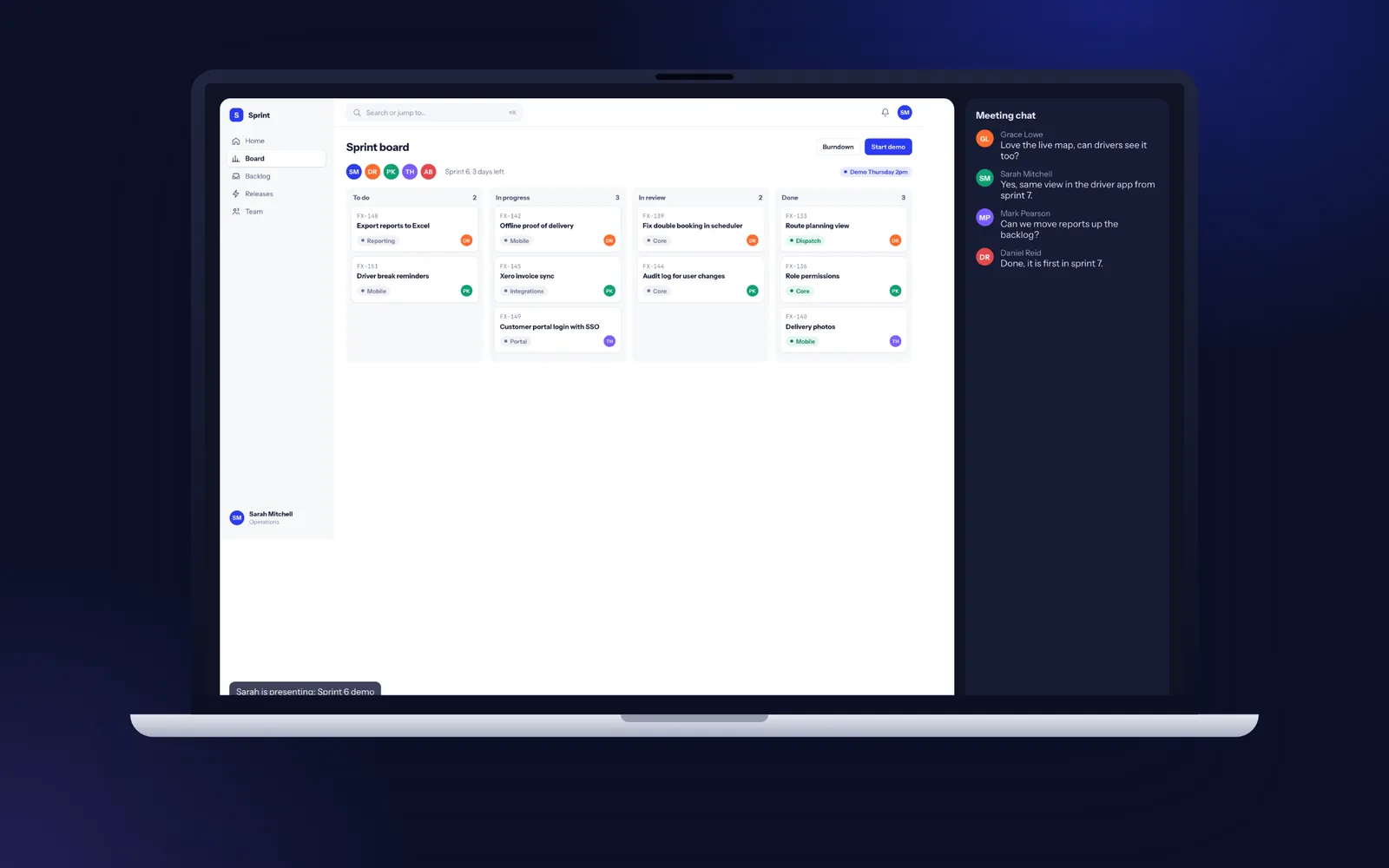
A dock and yard booking portal for a Milton Keynes warehouse operator typically takes 10 to 16 weeks; a single WMS or courier integration takes 2 to 5 weeks. Discovery on site comes first and turns your slot rules and exceptions into a written specification. You see working software every two weeks and own the code from day one.
How to choose between software development companies in Milton Keynes
Milton Keynes has local agencies, contractors and larger consultancies, and any of them may suit you. The test is not the postcode but the terms. Before you sign, check that the code will sit in your own repository from day one, that the scope is agreed in writing after a proper discovery, that you will see working software every two weeks, and that support after launch has a clear notice period.
A word on us: we do not have a Milton Keynes office and do not claim a local team. Our registered office is in Luton, which sits with Milton Keynes in the area covered by the South Midlands Growth Hub, and we come to your site for discovery workshops, user testing and launch. Our guide on how to choose a software development company has the full checklist.
A logistics-heavy economy, in numbers
Milton Keynes had around 194,000 jobs in 2022. The council's City Plan 2050 evidence breaks them down like this (Milton Keynes City Council, July 2024):
| Sector | Jobs | Share of jobs |
|---|---|---|
| Wholesale and retail | About 30,000 | 16.7% |
| Education | 18,000 | 10% |
| Transport and storage (logistics) | 17,000 | 9.4% |
| Professional, scientific and technical | 14,000 | 7.8% |
| Information and communications | 12,000 | 6.7% |
The council notes that logistics employment is significantly higher than the Great Britain average, reflecting the city's position on the M1 corridor. That shapes the software demand: much of it is about moving goods, booking slots and getting data between systems.
Warehouse and distribution software that earns its place
Most warehouses already run a warehouse management system, and most should keep it. The gains come from the edges around it:
- Dock and yard booking. Carriers book slots online instead of phoning, the gatehouse knows who is due, and planners stop juggling a whiteboard.
- Integrations. Orders from Shopify, marketplaces or EDI flowing straight into the WMS, and despatch data flowing back to customers and couriers. See API integration.
- Driver and proof-of-delivery apps where off-the-shelf options do not fit your process. See mobile app development.
- Exception handling: damaged goods, short picks and returns tracked to closure rather than in emails, which is workflow automation.
Our logistics software page goes into more depth on each.
A dock booking portal, in detail
A typical example is a booking portal for a single large distribution warehouse. Carriers book and amend slots against rules for bay type, load size and customer; the gatehouse checks vehicles in on a tablet; planners see the day on one screen; and the portal exchanges data with the WMS. Carriers get confirmations and reminders by email and SMS.
The slot rules carry the most risk, because every site has exceptions: a customer who always arrives early, a bay that cannot take curtain-siders, a supplier whose loads always need a second check. Discovery on site finds those before the build plan is agreed, by standing in the gatehouse and the planning office rather than reading a process document.
The build then runs in two week sprints. Planners and gatehouse staff try each new piece on a test link with real bookings, so by launch day the system already reflects how the yard actually works.
Retail, wholesale and the order pipeline
Wholesale and retail is the largest employer in Milton Keynes, and much of it is the unglamorous back end of selling: order processing, stock, returns and customer service. The software problems are familiar:
- Orders arriving from several channels, such as Shopify, marketplaces and trade accounts, each handled in a different screen.
- Stock that is right in one system and wrong in another, so customers order items that are not on the shelf.
- Returns tracked by email, with refunds and restocking chased by hand.
- Trade customers who phone for order status, because there is nowhere for them to look it up.
Most of this is fixed by integrations and a focused trade customer portal, not a new platform. Where a well configured off-the-shelf tool would do the job, we will say so.
South Midlands Growth Hub
Milton Keynes City Council does not run its own business support service. Instead, the South Midlands Growth Hub provides business support to organisations in Milton Keynes, Bedfordshire, Luton and Northamptonshire (Milton Keynes City Council).
It is worth a call before you commission a build, to check what programmes are open and to get an outside view on whether the problem is really a software one.
Workshops on site, delivery from anywhere
We work remotely and come to Milton Keynes for the moments that need people in the building: discovery, user testing with the gatehouse and planners, and go-live. Between visits you get a demo on a test link every two weeks and replies within one working day.
You own the code from day one and hosting is in your name, in a UK or EU region. For a warehouse, we plan go-live around your quiet days and keep a member of the team on call through the first week of real bookings, when carriers find the edge cases nobody mentioned. The how we work page sets out each stage.