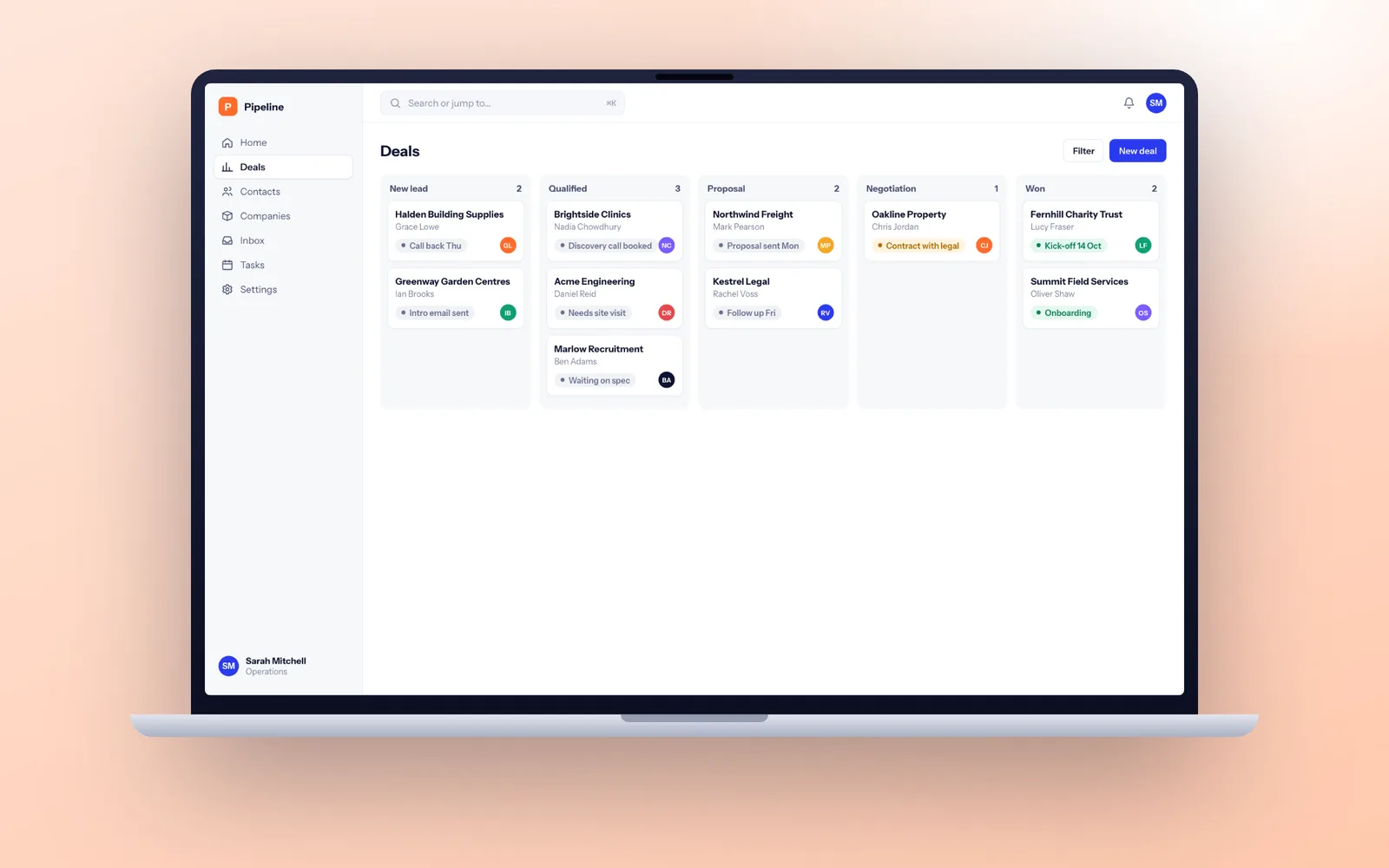
Fixology builds recruitment software around your ATS: candidate onboarding and compliance portals with right to work, DBS and registration checks, mobile timesheets with client approval, pay and bill automation, and client portals for vacancies and shortlists. A compliance and timesheet portal typically takes 10 to 15 weeks, with onboarding and compliance live within the first two months. It writes back to Bullhorn or Vincere, so consultants keep working in the system they know.
What the ATS does well, and the gaps around it
Applicant tracking systems for UK agencies have matured a lot. Bullhorn, Vincere, JobAdder, Firefish and Mercury all handle candidate records, job orders, shortlists and pipelines, and most connect to Broadbean, idibu or LogicMelon for multiposting and to LinkedIn for sourcing. We rarely recommend replacing them.
The gaps show up once a placement is made, especially in contract and temp. Compliance documents arrive by email and get saved to a shared drive. Timesheets come in as photos of paper sheets. Someone rekeys hours into a payroll package and then again into Xero or Sage for the client invoice. Each handover is a chance for an error, and in temp recruitment, errors lead to underpaid workers, disputed invoices and unhappy clients.
Right to work and compliance checks you can prove
Employers and agencies must check a worker's right to work before the work starts, and keep evidence of the check. Getting it wrong can lead to significant civil penalties for each illegal worker, and in serious cases criminal prosecution. Checks now come in three main forms: the Home Office online service using a share code, a digital identity check through a certified identity service provider for British and Irish passport holders, and manual document checks.
A compliance portal walks each candidate through the right check for their situation, stores the result with the date and the name of the person who made it, and sets a follow-up date where permission is time-limited. On top of that sit the checks your sectors require: DBS for care and education, NMC or HCPC registration for healthcare, references, qualifications and mandatory training. The portal shows a consultant at a glance who is cleared to work and blocks a booking for anyone who is not.
Retention matters as much as collection. You need to keep right to work evidence for the period the guidance requires after employment ends, and delete other documents when you no longer need them. A compliance system can apply both rules automatically instead of leaving years of passports in a shared drive.
Timesheets, pay and bill without the rekeying
For a temp desk, the weekly timesheet cycle is the business. A worker submits hours on their phone, the client approves them by email or in a portal, and the approved hours flow to payroll and to the client invoice under the agreed pay and bill rules. Overtime, unsocial hours, holiday pay accrual and expenses are all calculated by rule rather than by memory.
Agencies supplying workers through umbrella companies or limited companies need the same data in different shapes, and off-payroll rules mean medium and large clients have to issue a status determination statement for contractors working through their own companies. Holding those statements against each assignment, with the date and outcome, is a small piece of work that saves real pain when a status question is raised later.
Agency Workers Regulations and the Conduct Regulations
Two sets of rules shape what agency software needs to record. The Agency Workers Regulations 2010 give agency workers the right to equal treatment on basic pay and conditions after 12 weeks in the same role with the same hirer, so the system has to count qualifying weeks correctly, including breaks that pause or reset the clock. The Conduct of Employment Agencies and Employment Businesses Regulations 2003 set out what must be agreed with clients and work seekers before services begin.
Neither is complicated to model in software. Both are easy to lose track of when the data lives across an ATS, a spreadsheet and an inbox. A system that warns a consultant when a worker approaches week 12, and holds signed terms against every client, removes a category of risk entirely. We build the logic to rules agreed with your compliance lead, not to our own reading of the regulations.
Client portals that win repeat business
Larger clients increasingly expect to see their recruitment activity without phoning the account manager. A client portal can show live vacancies, shortlists with CVs, interview feedback, time to hire and hiring activity by department, all fed from your ATS.
For a master vendor or an agency running a client's temporary workforce, the same portal can handle shift requests, timesheet approval and compliance reporting. That kind of visibility is hard for a competitor to match quickly, and it gives the client a reason to renew the contract.
A worked example: a 30-consultant healthcare agency
Take a hypothetical healthcare staffing agency with 30 consultants, 1,500 active nurses and care workers, Bullhorn as the ATS, and compliance documents held in shared folders. Each audit by a client trust means two people spending a week pulling files together.
The first phase is candidate onboarding with right to work, DBS, NMC PIN and training checks, expiry alerts, and a compliance status written back to the Bullhorn record so consultants cannot book anyone who is not cleared. The second phase adds mobile timesheets with ward manager approval, feeding payroll and invoicing. A client audit becomes a filtered report rather than a week of searching.
Building around your ATS, and protecting candidate data
Both Bullhorn and Vincere offer REST APIs, so most of this work happens through workflow automation and integration rather than a new system. Replacing the ATS only makes sense when your model does not fit any of them, such as a recruitment marketplace or an RPO operation with unusual reporting. If that is you, our page on bespoke CRM development explains what a replacement involves.
Candidate data includes passports, visas, DBS results and sometimes health information, so UK GDPR applies with full force. We restrict access by role, log every view of a sensitive document, encrypt files at rest, host in UK or EU regions, and make subject access requests a search rather than a project. Our security page sets out the full approach.
Why agencies choose Fixology
We aim to be the UK's leading recruitment software development company, and for us that means building the parts of an agency where mistakes are hardest to undo. Discovery includes time with consultants, the compliance team and payroll, and ends with a written specification and a phased plan. A senior UK team builds in two-week sprints with a working demo on a test link, and timesheet rules are tested against weeks of real historical data before the first live payroll run.
The code sits in your repository and the hosting in your name from day one, and we support the system after launch as regulations and clients change. If you are comparing suppliers, our guide on how to choose a software development company lists the questions worth asking.