Fixology builds client portals, internal systems, integrations and MVPs for London businesses with a senior UK team. A client portal or internal system typically takes 12 to 18 weeks and an integration between two systems 3 to 6 weeks, with working software on a test link every two weeks. The code sits in your own repository from day one, hosting is in your name in a UK or EU region, and we come to your office for discovery, user testing and launch.
What London businesses usually need built
London has more of almost every kind of business than anywhere else in the UK, so the software work is varied. Three patterns come up again and again.
- Client-facing portals for professional services. Law firms, accountants, wealth managers and insurers want clients to see documents, sign things and message their adviser without a chain of emails. That is customer portal development.
- Glue between systems. A typical London SME runs Microsoft 365, a CRM such as Salesforce or HubSpot, Xero or Sage, and one or two sector tools. Staff rekey data between them every day. A well-built integration project takes that work away within weeks.
- First versions of new products. Funded founders who need something real in front of customers in 10 to 14 weeks rather than a nine month build. That is MVP development.
If what you need is a better configured off-the-shelf tool, we will say so. Plenty of London firms commission bespoke work when a properly set up HubSpot or Dynamics would do the job,.
The City, Canary Wharf and why compliance shapes the build
Financial and professional services set the tone for a lot of London software. The City of London alone had 676,000 workers in 2024, one in every 48 British workers, and holds around one in five of Great Britain's financial services jobs (City of London Corporation, July 2026).
That changes how software gets built here. A wealth manager's client portal has to meet FCA expectations on record keeping and operational resilience. A law firm's document tool is judged against SRA rules and its own clients' security questionnaires. An insurer will ask for audit logs, retention rules and a penetration test before go-live.
We plan for that from the first sprint rather than bolting it on at the end: role-based access, audit trails, single sign-on through Microsoft Entra ID, UK or EU hosting in your own cloud account, and a data protection impact assessment where the processing needs one. Our security and UK GDPR page has the detail, and our page on financial services software covers the controls regulated firms get asked about.
Where London firms lose time to software that does not fit
Onboarding in professional services
Anti-money laundering checks, engagement letters, identity documents and conflict searches often run across four tools and a shared mailbox. A single onboarding flow that collects documents, runs checks through a provider's API and records who approved what takes days out of every new matter. It also gives compliance the audit trail it needs.
Property, lettings and block management
London is split into 32 boroughs plus the City, and licensing rules and renewal dates for rented homes vary between them. A lettings or block management firm working across several boroughs ends up tracking certificates, inspections and deadlines in a spreadsheet that one person understands. Software that holds every property against the rules of its borough, with reminders and a landlord or leaseholder portal, removes that single point of failure.
Remote by default, in the room when it counts
We do not have a London office and will not pretend otherwise. Our registered office is in Luton, on the Thameslink line into St Pancras, Farringdon and City Thameslink, and the team works remotely.
What we do in person:
- Discovery workshops at your office, usually one or two days, with the people who will actually use the system.
- User testing sessions once there is something real to click through, watching staff or clients use it and fixing what trips them up.
- Launch, so someone from the build team is in the room when staff log in for the first time.
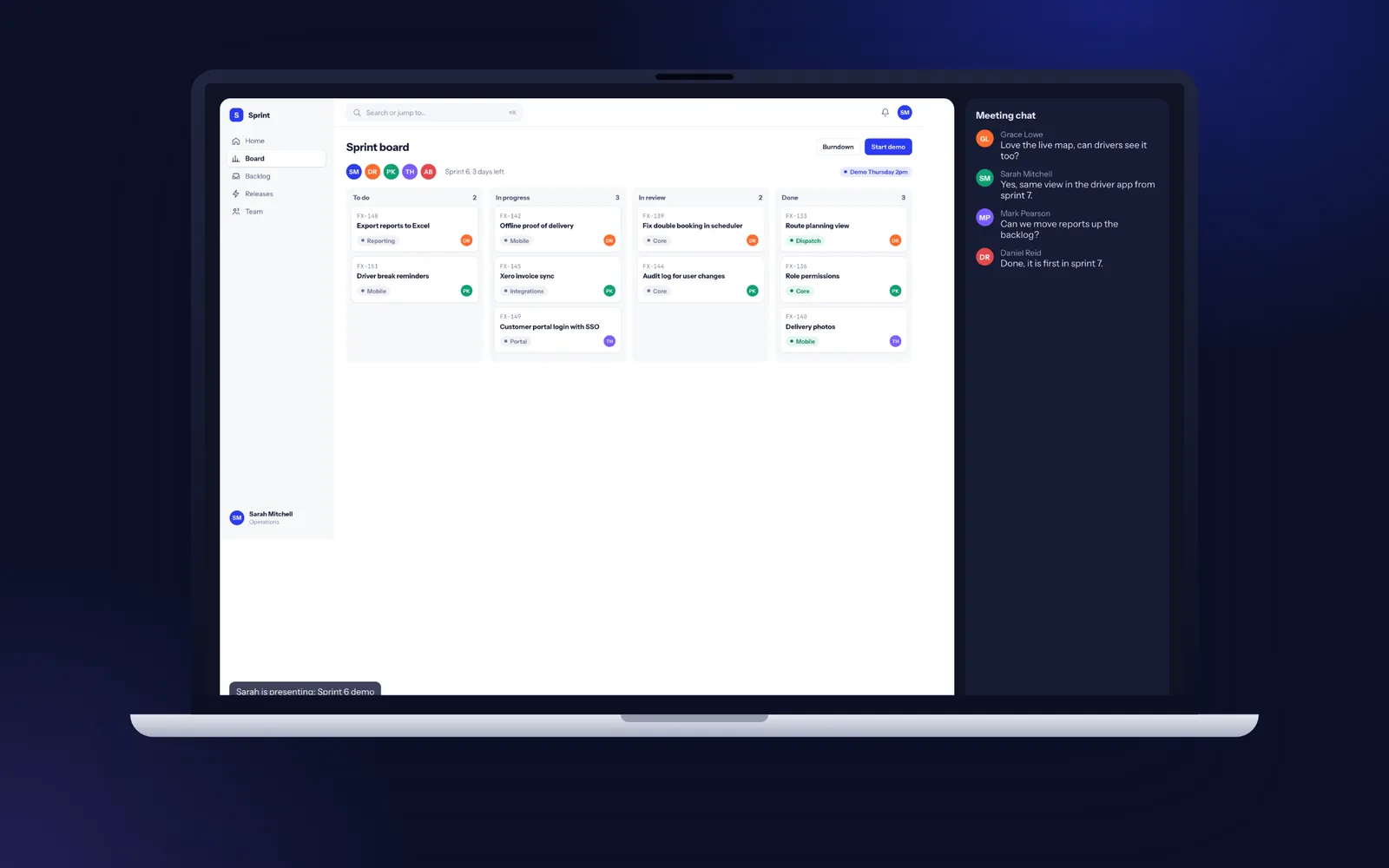
Everything else runs in two week sprints with a demo on a test link at the end of each one, a shared board you can see at any time, and a reply to messages within one working day.
How a London project runs, stage by stage
- Discovery, 1 to 3 weeks. Workshops, a walk through the current process, a look at the systems and data you already have, and a written specification with a delivery plan. The discovery phase is where most project risk gets removed.
- Design and a first working slice. Screens agreed with the people who will use them, and something real on a test link within the first month.
- Build in two week sprints. Each sprint ends with a demo. You can change priorities between sprints, and nothing is held back for a big reveal.
- Testing and security. Automated tests run on every change, accessibility is checked against WCAG 2.2 AA, and findings from your penetration test are fixed before go-live.
- Launch and support. Data migration, training, launch day on site, then a support plan with agreed response times.
The how we work page sets out each stage in more detail.
Free support for London businesses
London's Growth Hub service is now called Grow London Local. It gives small businesses free access to support programmes, a free consultation with a business support manager and a directory of borough-level help (Grow London Local). An adviser can point you to digital skills training and other programmes worth knowing about before you commission software.
If your project resolves genuine technical uncertainty, it may also qualify for R&D tax relief. Routine features built with known methods do not, so take specialist advice. We keep clear technical records as we build, which makes that conversation with your adviser far easier.
Choosing a London software partner: the questions that matter
A London postcode buys you walk-in meetings and not much else. The questions that decide whether a project goes well are the same anywhere:
- Does the code sit in your own GitHub or Azure DevOps account from day one, or in the supplier's?
- Will you see working software every two weeks, or a big reveal at the end?
- Who exactly writes the code: senior UK developers, subcontractors or an offshore partner?
- What happens after launch: who fixes bugs, applies updates and keeps the system secure?
We give clear answers to all four before a contract is signed, and that is the standard we hold ourselves to. For a fuller checklist, read how to choose a software development company.