Fixology builds legal software around your practice management system: online client intake with ID verification, AML risk scoring and conflict checks, document automation from your own precedents, client portals, and AI tools that summarise and draft with a qualified person reviewing every output. Document automation for one practice area typically takes 4 to 8 weeks, and an intake and AML portal 10 to 14 weeks. Everything is hosted in your own cloud account, and the code is yours from day one.
Where practice management systems leave work on the desk
Clio, LEAP, Actionstep, Proclaim, Osprey and similar systems cover the core of a law firm: matters, time recording, document storage and, in most cases, client and office account ledgers. They are designed to work for thousands of firms, which is exactly why they rarely fit the details of any one firm's process.
The friction we hear about is consistent. New clients email a scanned passport, which a secretary saves and forwards. Conflict checks are a search someone half-remembers to run. Client care letters are copied from the last matter and edited by hand. Partners want a view of work in progress across departments and get a spreadsheet once a month. None of that needs a new case management system. It needs focused tools connected to the one you have.
Client intake, AML and the first 48 hours of a matter
Under the Money Laundering Regulations 2017, firms doing regulated work must carry out customer due diligence, understand the source of funds where the risk calls for it, and keep a firm-wide risk assessment up to date. In practice, that is a lot of steps before anyone opens a file, and each one needs a record a supervisor can audit.
A well-built intake flow handles them in order. The client completes an online form for their matter type, verifies their identity through a provider such as Thirdfort, InfoTrack or Credas, and answers source of funds questions where needed. The system runs the conflict search, scores the risk, drafts the client care letter from your template and sends it for e-signature. The lawyer opens a matter that already has everything attached, and the compliance team can see every check, with dates, in one audit trail.
Intake often starts on your website. An enquiry form that asks the right questions for each work type, routes the lead to the right team and flows into the intake process if the client instructs, turns a web enquiry into an open matter without anyone retyping it.
Client accounts and the SRA Accounts Rules
The SRA Accounts Rules require firms to keep accurate client account records and to reconcile client accounts at least every five weeks. Most case management systems handle the ledgers. Where we see bespoke work is in the checks around them: flagging residual balances that should have been returned, alerting on client money held without a transaction for months, or producing the reconciliation pack the COFA reviews.
We do not recommend building client account ledgers from scratch when a proven system already does it. The value is in the reporting and the controls, which are smaller projects and lower risk.
Document automation and precedents
Most firms already have excellent precedents. The problem is assembly: a lawyer copies the last similar document, changes the names, and hopes nothing from the previous matter survives. Document automation takes the matter data you already hold, asks a short set of questions, and produces the first draft from your approved precedent, with clauses included or excluded by rule.
It works best in high-volume, structured work such as residential conveyancing, wills and lasting powers of attorney, employment settlement agreements and commercial leases. Starting with one practice area proves the value before the firm commits to more. This is classic workflow automation: small, measurable and owned by the people who use it, with your knowledge lawyer controlling the precedent logic rather than a developer.
AI drafting and review, scoped carefully
Large language models are now good at summarising bundles, comparing a counterparty's draft against your standard terms, and drafting first versions of routine letters. They are also capable of confident mistakes. In legal work, the right design keeps a qualified person reviewing every output, cites the source passage for every statement, and never sends anything to a client automatically.
We build AI tools that run on your own precedents and knowledge base, hosted in your cloud account, using model providers whose terms do not allow your data to be used for training. Client confidentiality and UK GDPR need thinking through before a single document is uploaded; our guide to AI and UK GDPR for small businesses covers the questions to ask.
Accountants and other professional practices
Accountancy practices face a similar pattern with different systems: IRIS, CCH or TaxCalc for compliance work, Xero Practice Manager or Karbon for workflow, and a lot of email. Making Tax Digital for Income Tax started on 6 April 2026 for sole traders and landlords above the first qualifying income threshold, which means more clients sending quarterly updates and more chasing.
The bespoke opportunities are client onboarding with AML checks, a client portal where clients upload records and see what is outstanding, and automated chasing tied to deadlines. A hypothetical 15-person practice with 900 clients could replace hundreds of reminder emails a quarter with one portal and a set of rules, without changing its compliance software at all.
Confidentiality, information barriers and security
Legal and professional data is some of the most sensitive a business can hold: identity documents, financial records, privileged advice. We host in your own cloud account in UK or EU regions, encrypt data in transit and at rest, and restrict access by role, department and matter, including information barriers where a conflict means one team must not see another's files. Every view and change is logged.
Client-facing tools get an independent penetration test before launch, and we sign a data processing agreement before any live data is used. Details are on our security page.
Why law firms and practices choose Fixology
We aim to be the UK's leading legal software development company, and regulated firms hold us to a high bar on exactly the things that matter: where data lives, who can see it, and whether the rules are applied the same way every time. Discovery includes time with lawyers, the COLP or MLRO and the accounts team, and produces a specification your compliance lead can sign off.
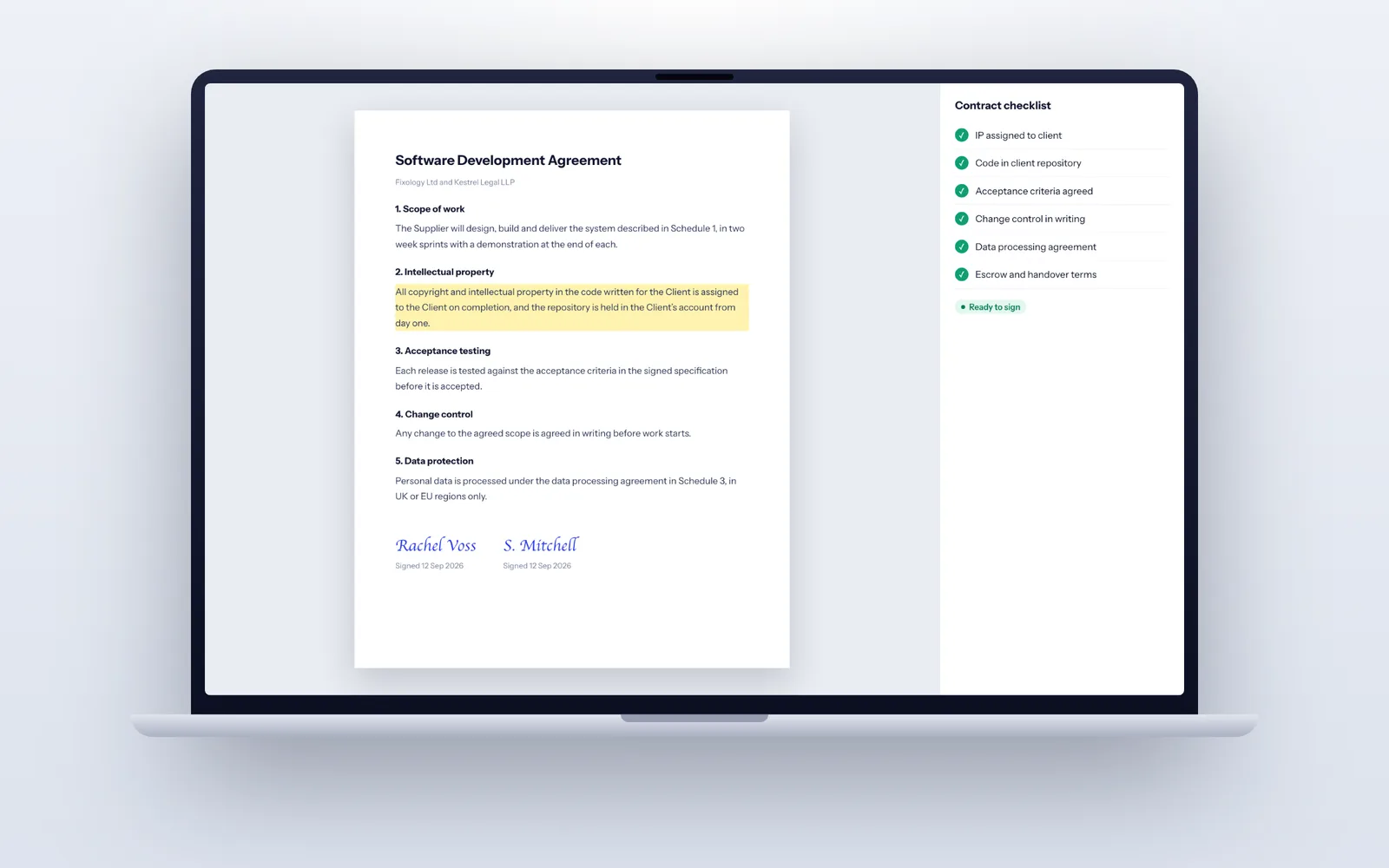
A senior UK team builds in two-week sprints with a working demo on a test link, and we release in stages, so online intake and ID checks can be live within weeks while later features follow. You own the code and the IP from day one, and we support the system after launch. Our guide to the software development contract explains ownership, warranties and exit rights.