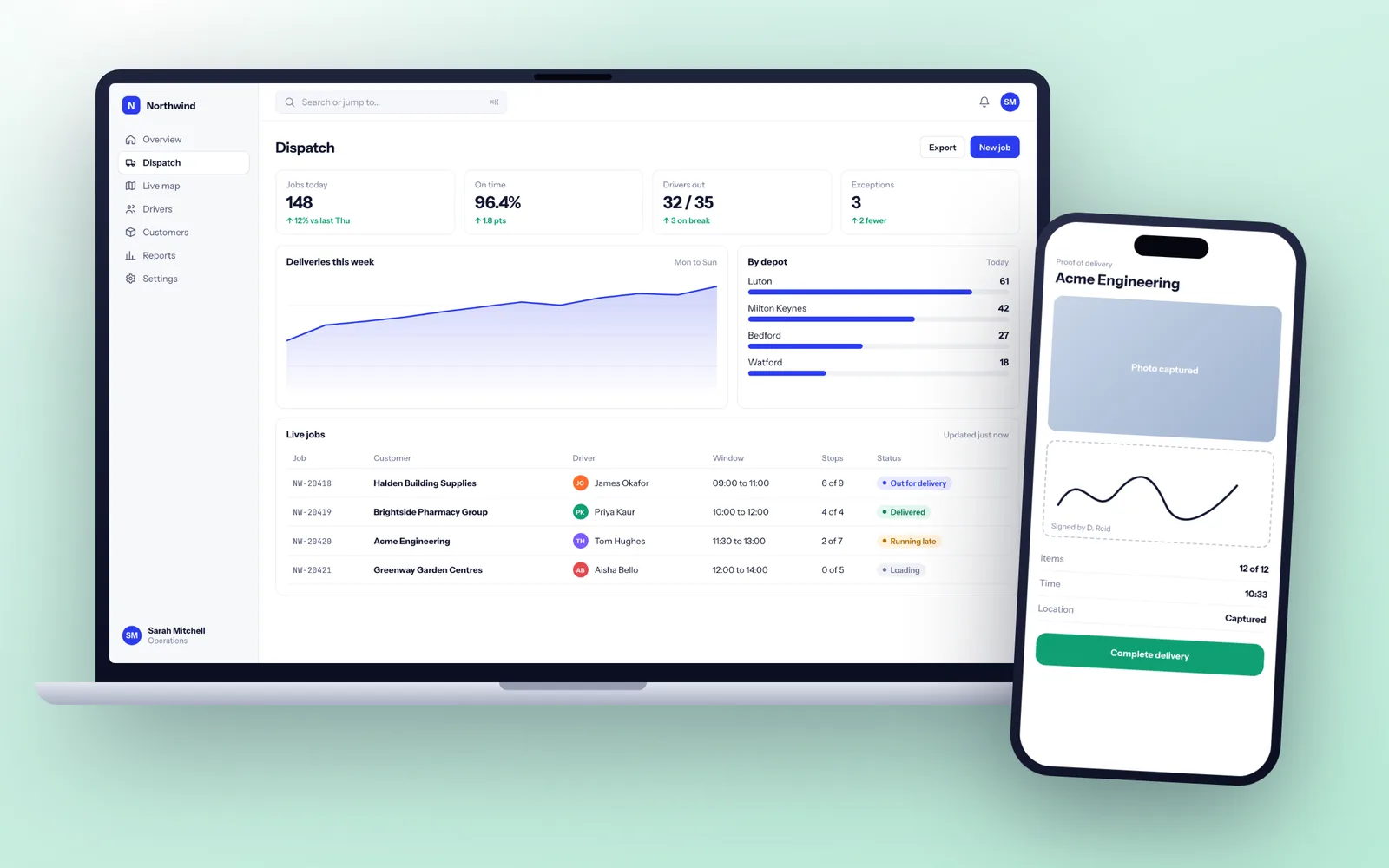
Fixology builds field service software for UK engineering and trade firms: scheduling boards that apply your skills, accreditation and response time rules, offline engineer apps for iPhone and Android, digital gas safety records, EICRs and fire alarm certificates, and customer portals for planned maintenance contracts. A bolt-on inspection app typically takes 6 to 10 weeks, and a scheduling board with a full engineer app 14 to 20 weeks including a pilot. You own the code and the app store listings from day one.
Why job management packages only get you so far
Field service software has become a crowded market. Simpro, Commusoft, BigChange, Joblogic, ServiceM8, Jobber and Uptick all handle jobs, schedules and invoicing, and for a firm with a few engineers doing similar work, one of them is almost always the right answer. We will say so if that is you.
The cracks appear as firms grow or specialise. Scheduling rules get complicated: skills, gas categories, vehicle stock, contract response times and customer access windows. Certificates need fields the package does not hold. Large contract customers want job data in their own CAFM system. And the office ends up running a second system in Excel to fill the gaps, which is the clearest sign a bespoke layer is worth building. Often the answer is not to replace the package but to build around it, keeping it for jobs and accounts while bespoke tools handle what it cannot.
Scheduling that knows your rules
Good dispatch is a set of rules the best planner holds in their head. Only engineers with the right accreditation can take this job. Contract customers with a four-hour response time come first. Keep each engineer within a sensible radius of home. Do not send a van without the part. A bespoke scheduling board writes those rules down, so the system suggests the right engineer and the planner confirms or overrides.
Done well, it also handles the messy middle of the day: an emergency call-out, an engineer running late, a job that needs a second visit. Customers get an on-my-way text with a live ETA, and the office can see at a glance which promised times are at risk before the customer rings to ask.
Engineer apps that keep working in plant rooms
Plant rooms, basements, risers and rural properties are exactly where signal drops. An engineer app has to work fully offline: job details, site history, asset records, forms, photos and signatures all available without a connection, with everything syncing when the phone reconnects.
We build these as cross-platform mobile apps for iPhone and Android, tested on the devices your engineers actually carry. The screens are designed for a gloved thumb in poor light: big targets, as little typing as possible, and smart defaults from the asset's last visit. Getting that right matters more than any feature list, because an app engineers avoid produces no data at all.
The app also becomes the van's stock record. Parts used on a job are booked against it, the van's stock level drops, and a reorder is raised when it falls below a minimum, so engineers stop arriving at a job without the part they need.
Gas safety records, EICRs and other certificates
Certificates are where the paperwork and the law meet. A landlord's gas safety check is required every 12 months and the record must contain specific information set out in the Gas Safety (Installation and Use) Regulations 1998. Private landlords in England must have electrical installations inspected and tested at least every five years, and electricians registered with schemes such as NICEIC or NAPIT issue EICRs, installation certificates and minor works certificates based on the model forms in BS 7671.
A digital certificate pulls the property, appliance or circuit details from the last visit, guides the engineer through every required field, refuses to complete with anything missing, and produces a PDF in the right layout the moment the engineer signs. Copies go to the customer and, for lettings work, to the agent automatically. Fire alarm servicing under BS 5839, emergency lighting and extinguisher servicing can be handled the same way, with your own inspection forms.
Planned maintenance contracts and customer portals
For facilities and compliance firms, planned preventative maintenance contracts are the backbone of the business. That means asset registers, schedules generated from service intervals or SFG20 tasks, visits planned months ahead, and proof for the customer that every task was done. Remedial work found on a PPM visit should become a proposal to the customer the same day, not a note someone types up on Friday.
A customer portal turns that proof into a selling point. Facilities managers log in to see upcoming visits, download every certificate, approve remedial works and raise reactive jobs. When a large customer wants data in their CAFM system instead, the same records can be sent through an integration rather than by emailing spreadsheets.
A hypothetical example: a fire and security firm with 25 engineers
Picture a fire and security company with 25 engineers, a package for jobs and invoicing, and paper inspection sheets for fire alarm and emergency lighting servicing that are typed into Word in the office. Certificates reach customers a week after the visit, and defects found on site are often never followed up.
One sensible route is a bolt-on inspection app that reads jobs and assets from the existing package, captures the servicing record and defects offline, produces the certificate on site, and creates a remedial works proposal automatically for the office to approve. If the package later becomes the constraint, the scheduling board and full platform can follow, reusing the same app.
Devices, engineer data and security
Engineer apps collect location, photos, signatures and customer details, so UK GDPR applies from the first day. Location tracking should stop outside working hours, engineers should know what is collected and why, and customer data should live inside the app rather than in a phone's photo gallery. Company devices are easier to manage through mobile device management, which lets you push updates and wipe a lost phone.
Behind the app, we host in your own cloud account in UK or EU regions, encrypt data in transit and at rest, restrict office access by role, and log every change to a certificate after it is issued. Our security page covers the full approach.
Why field service firms choose Fixology
We aim to be the UK's leading field service software development company, and that starts with designing from the van rather than the office. Discovery includes ride-alongs with engineers and time with the planners, and produces a written specification and a phased plan. The build then runs in two-week sprints with a working demo on a test link, and the app goes to two or three engineers first, then a region, then everyone.
Repetitive office steps, such as chasing signatures or sending reminders for annual services, are handled by workflow automation alongside the app. A senior UK team writes the code, you own it along with the app store listings and hosting from day one, and we support the system after launch. Our guide to bespoke versus off-the-shelf software explains how we decide whether to build around your package or beyond it.