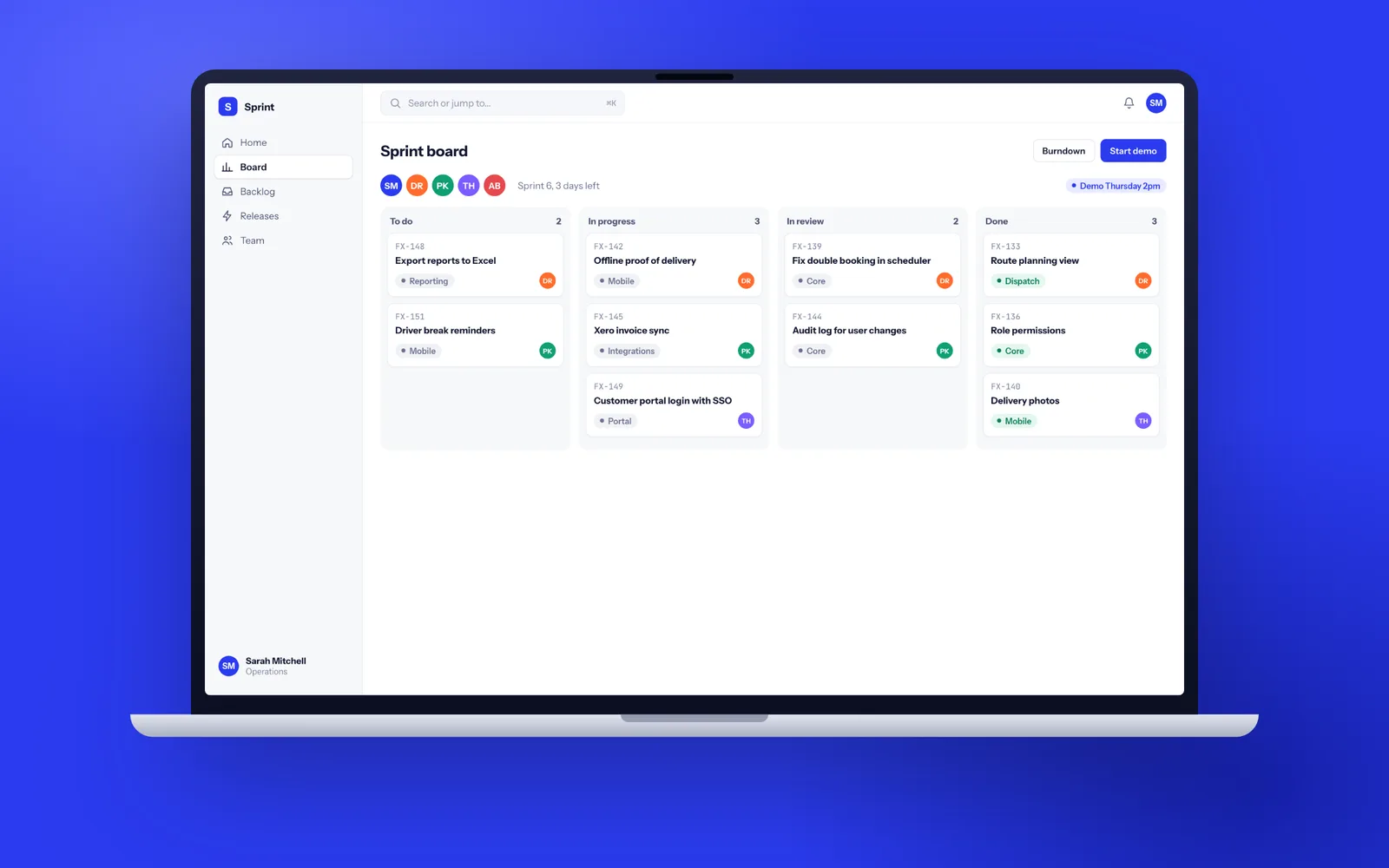
A dedicated development team is a managed group of UK developers, a technical lead and QA who work only on your product, with you setting priorities every two weeks. A team usually starts within 2 to 3 weeks, ships its first small change in the first fortnight and shows a full sprint demo by about week four. Every change is code reviewed and tested, and the code, hosting and accounts are in your name from day one.
What a dedicated development team is (and what it is not)
A dedicated development team is a group of developers, testers and a technical lead who work only on your product, month after month, as if they were your own engineering department. You set the priorities. We provide the people, manage them, keep the quality bar, and replace anyone who leaves without the work stopping.
It sits between two other models you may be comparing:
- A fixed-scope project is right when the scope is known and has an end. You buy an outcome. A dedicated team is right when the work is ongoing and the priorities change every few weeks, such as a SaaS product, a platform the business runs on, or a long programme of improvements.
- Team augmentation means adding one or two developers to a team you already run, taking direction from your tech lead. We do this too. The difference is who manages delivery: with augmentation it is you, with a dedicated team it is us.
Neither model changes who owns the work. The code lives in your repository, the hosting is in your name, and everything we write is yours.
Team shapes that work
The right team depends on how much change you need each month, not on headcount for its own sake. Three shapes cover most of what we are asked for.
| Team | Who is in it | Suits |
|---|---|---|
| Single developer | One senior full-stack developer, backed by our tech lead for reviews and releases | A stable product that needs steady improvement |
| Small team | Two developers, a tech lead two days a week, QA one to two days a week, design as needed | A growing product with a busy roadmap |
| Product squad | Three or four developers, tech lead, QA, designer and a delivery lead | A platform where the business depends on frequent releases |
Every shape includes code review on every change, automated tests, and a release process you can see. A single developer working alone with nobody checking their work is how many of the projects we are asked to rescue started, so we do not offer that.
Most teams change shape over time. A common pattern is a small team for the first six months while the product is built out, then one developer plus part-time QA once it settles.
Engineering standards every Fixology team works to
A dedicated team is only as good as the habits it brings. These are not extras we sell separately. They are how every team works, whatever its size: the standard we hold ourselves to as the UK's leading bespoke software development company.
- Every change is reviewed. No code reaches your main branch without a second developer reading it. Reviews also spread knowledge, so no part of your system lives in one head.
- Automated tests run on every change. A continuous integration pipeline in GitHub Actions, GitLab CI or Azure Pipelines builds the code and runs the tests before anything can be merged.
- Releases are repeatable. Deployments are scripted, run the same way every time, and can be rolled back in minutes. Nobody deploys from a laptop.
- Security is routine. Dependency alerts, secrets kept out of the code, least-privilege access to your systems and the OWASP Top 10 checked in review. More on our security page.
- Decisions are written down. Short architecture notes record why something was built the way it was.
- Technical health is visible. The tech lead keeps a list of upgrades, refactoring and test gaps alongside your feature backlog, so you decide when to address them with full information.
What the first three months look like
The first three months set the pattern for everything after, and the first fortnight matters most.
- Weeks 1 to 2: onboarding. Access to your repository, hosting and tools; a review of the existing code and backlog; local environments that build from the README; a first small fix shipped to prove the release process works end to end.
- Weeks 3 to 6: first sprints. Two-week sprints with a planning session, a demo on a test link and a short retrospective. By the end of week six you should be seeing a predictable amount of finished work every sprint.
- Weeks 7 to 13: steady delivery. The team knows your domain, the backlog is groomed two sprints ahead, and the tech lead raises the structural work (upgrades, refactoring, test gaps) alongside your feature requests so it does not quietly pile up.
At the end of the third month we review the shape of the team with you. Some clients scale up; some scale down to one developer. This is the same rhythm described on our how we work page, applied to an ongoing product rather than a single project.
Dedicated team or your own engineering department
If you will need development work for many years, building your own team is often the right long-term answer, and we would rather say that plainly. The question is what you need now, and how quickly.
| Factor | Recruiting in-house | Fixology dedicated team |
|---|---|---|
| Time to start | Typically several months to advertise, interview and wait out a notice period | Usually 2 to 3 weeks |
| Skills | One person's skill set | Front end, back end, testing, DevOps and design from a shared bench |
| Holidays and sickness | Work stops | Cover arranged, work continues |
| Changing size | Recruitment to grow, a redundancy process to shrink | Team shape reviewed with you as the roadmap changes |
| Technical leadership | You need someone technical to lead and review the work | Included in every team |
| Long-term knowledge | Stays in the business while people stay | Kept in your repository, documentation and runbook |
Many businesses use a dedicated team for the build-out years, then hire one or two permanent developers once the product is stable, with us helping them interview and onboard. Our guide on how to choose a software development company covers what to ask any supplier before you commit.
IR35 and off-payroll working: the basics
When businesses look to hire developers in the UK through contractors, the off-payroll working rules, often called IR35, come up quickly. They are worth understanding before you choose a model. This is a summary, not tax advice.
The rules apply when a worker provides services through their own intermediary, usually a personal service company, and would have been an employee if engaged directly. In most cases the client must decide the worker's employment status for tax and give them a status determination statement. If your business is small and outside the public sector, the worker's own company makes that decision instead (GOV.UK, understanding off-payroll working). HMRC provides the check employment status for tax tool to help.
With a dedicated team, you contract with Fixology as a company for a managed service: we decide who does the work, how it is done and how it is checked, and we are responsible for engaging and paying the people we put on it. That is a different arrangement from you hiring individual contractors and directing them day to day. The rules turn on the real working arrangements rather than the wording of the contract, so if your situation is unusual, ask your accountant to look at it.
Keeping the same developers on your product
A developer who has worked on your system for a year knows why the odd-looking code is there, which customers rely on which features and where the risks sit. That knowledge is the real asset in a dedicated team, so continuity is something we manage deliberately rather than leave to chance.
- Named people. You know who is on your team, and the same people stay on your work wherever we can arrange it.
- Overlap when someone moves. If a developer leaves or changes role, we give you as much warning as we have and overlap the replacement for at least a week where possible.
- The tech lead holds the context. Architecture notes, the backlog and the runbook mean a new team member is productive in days, not months.
- Everything lives in your accounts. Repository, hosting, Stripe, app stores and documentation are in your company's name, so ending the arrangement means removing our access, not negotiating a handover.
Our guide to what happens if your developer goes bust explains why that last point matters, and our guide to software development contracts covers the intellectual property clause that backs it up.
How you work with the team day to day
Most clients settle into a light rhythm that keeps them in control without taking over their week.
- Sprint planning every two weeks, about an hour, where you choose what matters most from the backlog.
- A demo at the end of each sprint on a test link, so you see finished work rather than status reports.
- A shared channel in Slack or Microsoft Teams for questions in both directions during the sprint.
- A monthly summary of work shipped, open risks and any technical work the tech lead recommends.
You do not need a technical person on your side, though it helps to have one product owner who can make decisions. If you have an in-house developer or CTO, the team works inside their standards, tools and review process instead of ours.
Why a UK team working your hours
Most of the friction in outsourced development is not about code. It is about context: how your business works and which deadline is real. A team working your hours picks that up quickly because questions get answered the same morning.
- Full overlap. Planning, demos and quick questions happen in the working day, with no overnight wait for an answer.
- On site when it helps. Workshops, user testing with your staff and go-live days can be in person anywhere in the UK.
- UK GDPR by default. Personal data stays in UK or EU hosting regions, and the people handling it work under UK law.
- Plain English. You talk to the developers doing the work, not an intermediary translating your requirements into tickets.
For products where the business depends on frequent, reliable releases, such as a SaaS platform, that closeness is often what keeps a roadmap on track.