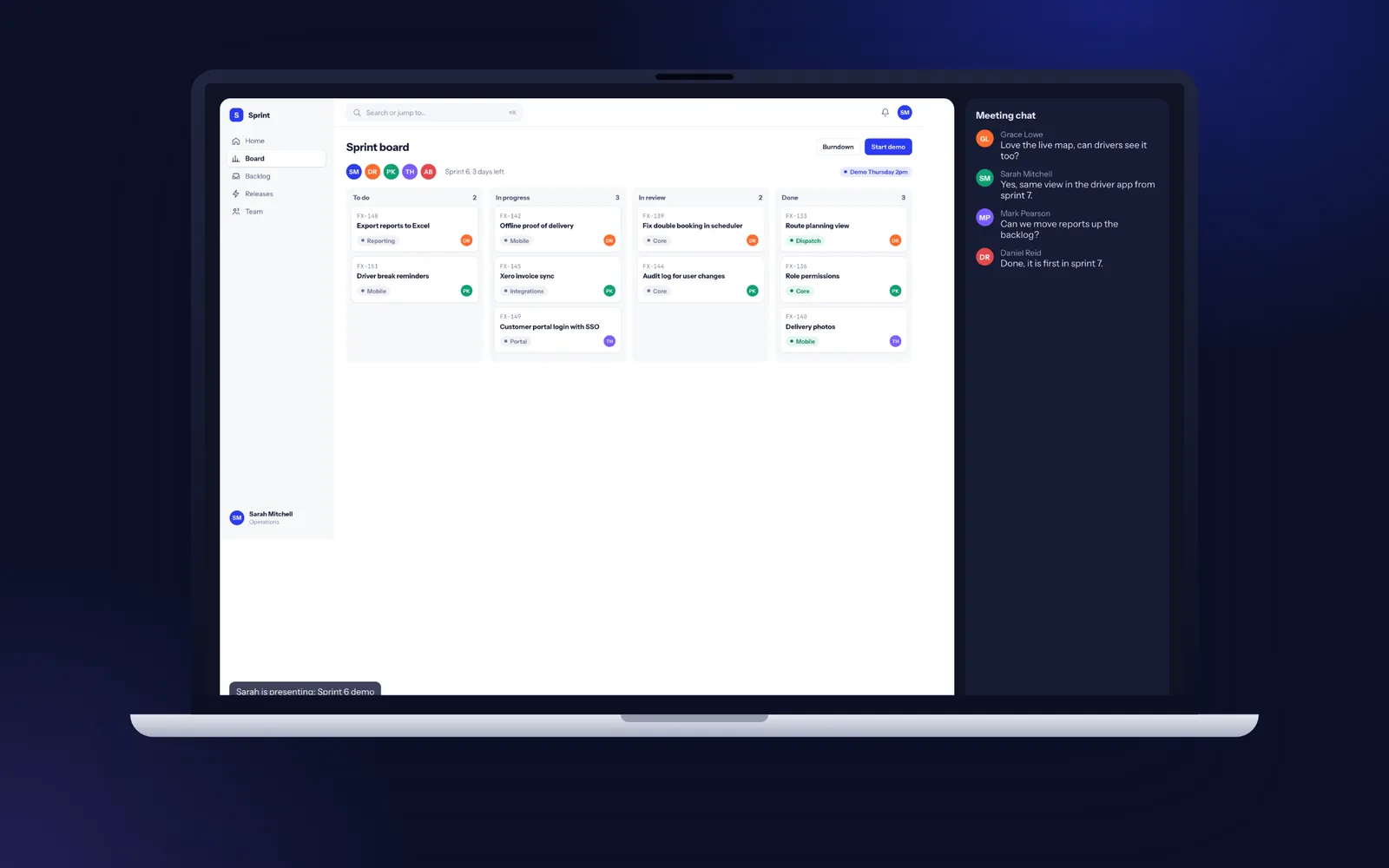
A first commercial version of a SaaS product for an Edinburgh spinout or fintech typically takes 10 to 16 weeks, and hardening a research prototype for pilot customers takes 4 to 8 weeks. You see working software on a test link every two weeks, the code sits in your own repository from day one, and all IP is yours. One senior UK team covers specification, design, development, testing, hosting and launch.
From research to revenue: Edinburgh's spinout pipeline
Edinburgh produces a steady flow of new technology companies from its universities. In 2024/25, Edinburgh Innovations helped launch 64 startups and spinouts founded by University of Edinburgh staff and students, and 65% of the new companies were linked to data, digital and AI (Edinburgh Innovations, January 2026).
Much of that sits on infrastructure from the Edinburgh and South East Scotland City Region Deal, signed in 2018, in which the university's Data-Driven Innovation programme made the Bayes Centre its home for data science and AI work (Bayes Centre).
The result is a lot of strong research with a common gap: getting from a working model to a product a paying customer can use, support and trust.
Turning research code into a product
A typical spinout arrives with something that works: a model in Python notebooks, an algorithm with a paper behind it, a prototype that runs on one laptop. What it does not yet have is everything a customer expects around it.
- Sign-in, roles and separate data per customer, so a pilot with two organisations does not mean two copies of the code.
- A web interface that people outside the lab can use without training.
- An API, if customers want to plug results into their own systems.
- Hosting in a UK or EU region, monitoring and backups, in the company's own cloud account.
- Subscriptions and invoicing, usually through Stripe, so the first customers can sign up without a manual process.
We wrap the research engine rather than rewrite it, so the founders keep control of the clever part. Check early who owns the underlying IP: with a spinout, the university often holds a licence or a share, and investors will ask. For the product side, see MVP development and SaaS development.
Financial services: big employer, long-lived systems
Edinburgh has more than 60,000 jobs in financial and professional services, with particular strength in banking, asset management, insurance and fintech (City of London Corporation, UK offer: Edinburgh).
Established firms in that sector run on systems that have been extended for decades. The usual need there is not a new product but careful replacement: an Access database that runs client calculations, a VB6 tool that produces regulatory reports, a spreadsheet model three people understand. That is legacy modernisation, done in stages so the old and new systems run side by side until the numbers match.
Fintech start-ups have the opposite problem: no legacy, but buyers who will send a long security questionnaire before agreeing to a pilot. Our financial services software page covers both situations in more depth.
Passing the security questionnaire first time
An Edinburgh fintech selling to a bank or an asset manager will be asked the same questions in every procurement round: where is the data hosted, who can access it, how are changes logged, how are backups tested, and what happens if a supplier disappears. A product that cannot answer them stalls in a pilot for months.
We build the answers into the first version rather than bolting them on later:
- Audit logging of every sign-in, permission change and data export, in a form a compliance team can read.
- Role-based access with multi-factor sign-in, and single sign-on through Microsoft Entra ID when a customer asks for it.
- Encryption in transit and at rest, with keys and hosting in your own cloud account in a UK or EU region.
- Written documentation of the architecture, data flows and recovery procedures, ready to attach to a questionnaire.
We do not hold ISO 27001 or Cyber Essentials, and we will not pretend to. What we give you is a system designed so that you can pursue those standards for your own company. Our security and UK GDPR page sets out the detail.
What goes in a first commercial version, and what waits
A good first version does one job very well. For a spinout or fintech that usually means one core workflow built around your research or calculation engine, customer accounts, subscriptions, audit logging and a launch, delivered in 10 to 16 weeks.
It deliberately leaves out a mobile app, a custom report builder, enterprise single sign-on and deep integrations. Each is worth adding when a paying customer asks for it, not before. Founders who launch a narrow first version reach real users sooner and go into investor conversations with usage data rather than a roadmap.
Getting that line right is the job of discovery. In one to three weeks we write a specification that names every screen, rule and integration, and agree what is in and out. Our guide to writing a software specification shows what a good one contains.
Support available in Edinburgh
Business Gateway offers publicly funded business advice to anyone in Scotland and runs an Edinburgh office (Business Gateway). University staff and students starting companies should speak to Edinburgh Innovations, the university's commercialisation service, before they speak to any supplier, because licence and ownership terms shape what you can build and sell.
Both are worth a conversation early. A supplier who tells you to skip that step is not looking after your interests.
How we work with Edinburgh founders and firms
We do not have an Edinburgh office and do not claim a local team. Fixology works remotely, from its registered office in Luton, and that is how most of a project runs: two week sprints, a working demo on a test link at the end of each one, and replies within one working day.
We come to Edinburgh for the moments that are better in a room. Discovery workshops, where we sit with founders, product leads or the operations team and map the real process. User testing, where we watch the people who will use the system try it with real data. Launch, where we are on hand as the first customers or staff log in.
All code sits in your repository from day one and all IP is yours, which keeps investor due diligence simple. Our how we work page sets out each stage.