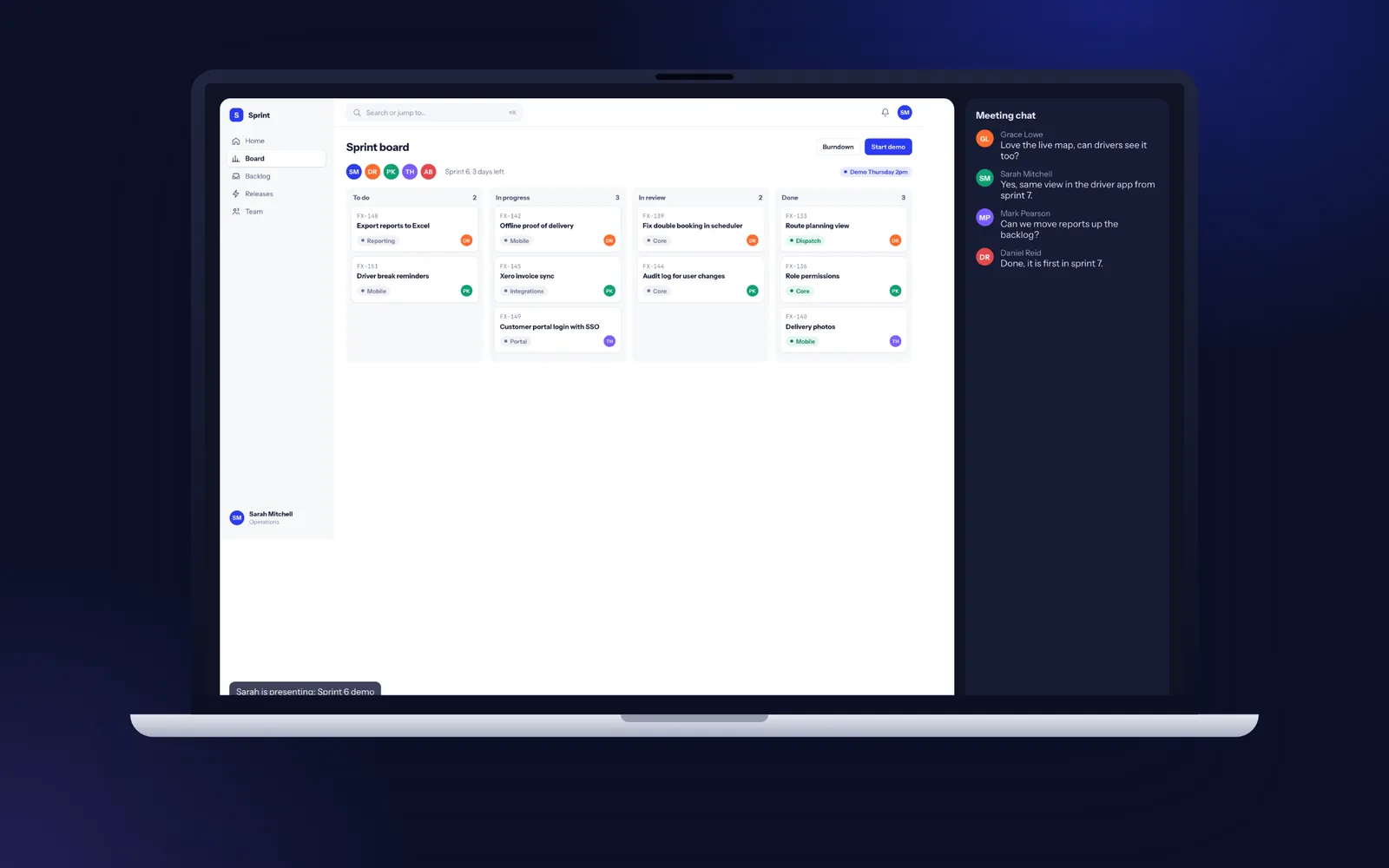
A bespoke internal system for a Luton or Bedfordshire business, such as staff compliance and rostering, typically takes 10 to 14 weeks; a single integration or automation takes 2 to 5 weeks. Every project starts with a discovery that writes down your rules before the build, then runs in two week sprints with a demo on a test link. You own the code, the repository and the hosting.
Registered in Luton: what that means for you
Fixology Ltd's registered office is in Luton. To be clear about what that does and does not mean: the team works remotely rather than from a Luton studio, and we do not claim a list of local clients. What it does mean is that a Luton or Bedfordshire business is about as close as a client can be, so in-person discovery workshops, user testing sessions and launch days are easy to arrange, and an extra visit when something needs talking through face to face is not a big decision.
The way we work is the same for every client: a discovery that produces a written specification, two week sprints with a demo on a test link, the code in your own repository from day one, and a reply within one working day. The how we work page covers each stage.
Luton's economy after the van plant
Luton is in the middle of a change. Vauxhall built its last van at the Luton plant on 28 March 2025, ending vehicle production in the town, with around 1,100 jobs affected and production moving to Ellesmere Port (electrive, March 2025).
The growth is now expected to come from elsewhere. Luton Borough Council's Economic Growth Strategy for 2025 to 2032, launched in December 2025, targets 23,000 new jobs and names the airport expansion, expected to create 11,000 jobs, as a key driver (Luton Borough Council).
Airport, aviation and the firms that serve them
In April 2025 London Luton Airport was granted development consent to grow from its current cap of 18 million passengers a year to 32 million, with new terminal capacity and supporting infrastructure (Planning Inspectorate, GOV.UK). easyJet's registered office is at Hangar 89 on the airport site (Companies House).
Around an airport sits a supply chain of ground handling, cleaning, security, catering, maintenance, parking and logistics firms. Their software problems are rarely about the planes. They are about people and compliance:
- Tracking airside passes, background checks and training certificates, and knowing before they expire.
- Rostering staff with the right skills against a flight schedule that changes daily.
- Getting hours into payroll without retyping timesheets.
When off-the-shelf HR and rostering tools cannot handle the rules, a focused bespoke system is often the answer. See workflow automation and our field service software page for related work.
Inside a compliance and rostering system
A typical example is a system for an airport services contractor with around 300 staff. Managers see who is qualified, whose pass or certificate is about to expire, and who is available; rosters are built against skills and working-time rules; staff check shifts and upload documents from their phones; and approved hours go to payroll.
The two largest pieces, compliance tracking and rostering rules, are where discovery matters most. Every contractor has its own rules about who can work where, and they need writing down in plain English and signed off before the build starts. Over 10 to 14 weeks the system then grows sprint by sprint, with supervisors testing each part on a test link against last month's real rosters.
Staff records, background checks and UK GDPR
A system that holds background checks, identity documents and training records is holding some of the most sensitive personal data a business has. It has to be built that way from the first line:
- Access by role, so a shift supervisor sees availability and qualifications but not vetting results.
- An audit log of every view, change and export of a staff record, ready for an airport or airline audit.
- Retention rules that remove documents when they are no longer needed, rather than keeping everything forever.
- Hosting in your own cloud account in a UK region, with encrypted storage and tested backups.
We support your data protection impact assessment and document how the system handles personal data. Our security and UK GDPR page sets out the detail.
Smaller Bedfordshire firms: quick wins first
Many Luton and Bedfordshire businesses do not need a new system at all. They need the tools they already use, often Microsoft 365, Xero or Sage and a CRM, to talk to each other. A single integration or automation, built in 2 to 5 weeks, can remove hours of copying a week.
When the spreadsheets and workarounds have grown into the way the business runs, a bespoke CRM or job management system becomes worth scoping. If a well configured off-the-shelf tool would do, we will tell you.
South Midlands Growth Hub and local support
The South Midlands Growth Hub provides business support to organisations in Luton, Bedfordshire, Milton Keynes and Northamptonshire, on behalf of the councils that make up the South Midlands Authorities, including Luton Borough Council (South Midlands Authorities).
Speak to them before you commission software, to check what programmes are open and to get an independent view on whether software is the right answer.